
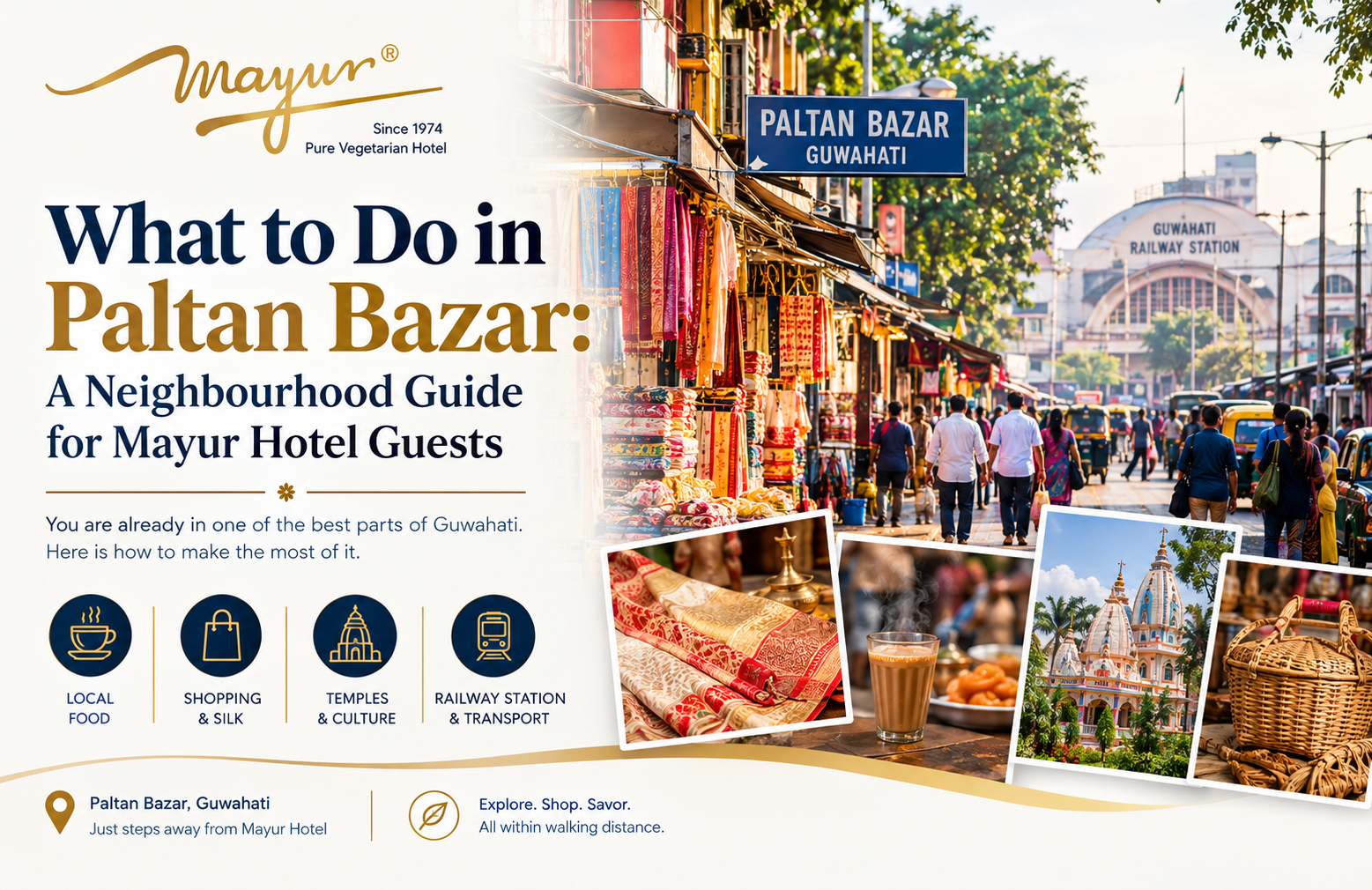
Most guests who stay at Mayur Hotel Guwahati spend their first few minutes outside the door looking around and wondering where to start. Paltan Bazar is not a neighbourhood that announces itself quietly. It is the commercial heart of the city: loud, busy, smelling of tea and incense and fried snacks, and immediately interesting if you let it be.
What most guests do not realise is how much is walkable from the hotel. The silk shops, the tea market, the railway station ghat for the Umananda ferry, street food stalls that open before the rest of the city wakes up, and several temples that see more locals than tourists on any given morning. This guide covers all of it, starting from the front door of the hotel.
Morning in Paltan Bazar
Start With the Street Before Breakfast
The area around Paltan Bazar comes alive well before 7 AM. The morning is the best time to walk it: the heat has not built, the street food stalls are frying their first batches, and the footpaths are moving but not yet impossible. Step out early and walk the length of the main road that runs parallel to the railway station.
The stalls here sell aloo puri, fresh chai, and jalebi from around 6:30 AM. You do not need to know the names. Walk toward whatever smells best and point. Tea in Guwahati is brewed strong, milky, and sweet by default. If you want it any other way, specify.
The Railway Station Area
Guwahati Railway Station is opposite the hotel and worth a short walk even if you are not travelling by train. The area around the station is where the city begins: shared taxis loading up for Shillong, buses heading east toward Kaziranga, porters, chai vendors, newspaper stalls. It is the kind of organised chaos that only major Indian railway stations produce, and it is genuinely interesting to watch from the perimeter for twenty minutes.
The prepaid taxi counter inside the station compound is also useful if you are planning a day trip and did not arrange a car in advance. The hotel front desk can also arrange vehicles, but the station counter is a backup option worth knowing about.
ISKCON Temple, Paltan Bazar
There is an ISKCON temple within easy walking distance of the hotel on GS Road. It is quieter and far less crowded than Kamakhya, and the morning aarti, usually at 7 AM, is attended mostly by local devotees rather than tourists. The atmosphere is genuinely calm and the courtyard is clean and well-kept. For guests who want a morning visit that does not involve a drive up Nilachal Hill, this is a good alternative.
Shopping: What to Buy and Where to Look
Muga Silk and Assamese Textiles
Paltan Bazar and the adjoining Fancy Bazar are the two best places in Guwahati to buy Assamese silk. The three types to know are Muga silk (golden in colour, unique to Assam, and the most prized), Pat silk (white to cream, smoother, more formal), and Eri silk (coarser, warmer, traditionally used for shawls). All three are available in the fabric shops along the main road and in the lanes running off it.
The mekhela chador, the traditional Assamese two-piece garment worn by women, is sold at most of these shops. Prices vary significantly by the silk type and the quality of the weave. A basic cotton mekhela chador starts around a few hundred rupees. A Muga silk piece with good hand weaving runs considerably higher. Bargaining is expected and normal in most shops here.
If you are not sure what you are buying, ask the shopkeeper to show you both a machine-woven and a handloom piece side by side. The difference in texture is visible and helps you understand what you are paying for.
Tea
Paltan Bazar has several shops selling loose-leaf Assam tea. Assam tea is a black tea grown in the Brahmaputra valley and is one of the strongest and most full-bodied teas in the world. Most of what is sold commercially in India and internationally as Indian tea is Assam tea blended with other varieties. Buying it loose leaf directly here means you are getting it in its original form.
The best way to choose is to ask for a small quantity of two or three different grades, smell them, and compare. The better shops will let you do this without pressure. Golden-tipped second flush teas are the premium variety. The everyday TGFOP grade is what most local families brew and it is excellent at a fraction of the price.
Bamboo and Cane Crafts
Northeast India has a long tradition of bamboo and cane craftsmanship, and Paltan Bazar has stalls and small shops selling baskets, trays, and household items made from both. These are genuinely made locally, not imported, and they are priced for the local market rather than for tourists. A good bamboo basket or a cane storage tray is one of the most useful and honest things you can bring back from Guwahati.
Tribal artefacts — carved wooden pieces, clay items, items made from water hyacinth — are also available in the market. Look for the shops that stock a narrower, more considered selection rather than the ones that pile everything together. The former are usually run by people who know what they are selling.
Fancy Bazar: The Next Lane Over
Fancy Bazar is a short walk from Paltan Bazar and is considered Guwahati's main shopping district. It is denser, slightly more upmarket than Paltan Bazar, and better for ready-made clothing, footwear, and accessories. The Assam Emporium on GS Road near Fancy Bazar is the government-run fixed-price shop for authentic Assamese handicrafts. No bargaining needed and the quality is reliable. It is the right place to buy if you are not confident about what you are looking at in the open market.
What to Do Within a Short Ride
Umananda Island Temple (20 minutes)
The ferry to Umananda Island leaves from the ghat near the Assam Secretariat and Kamrup District Court, about a 15-minute auto ride from the hotel. The crossing takes 10 minutes and puts you on a small river island in the middle of the Brahmaputra with a 17th-century Shiva temple and views of the river in every direction. It is one of the most peaceful places in Guwahati and almost entirely without tourist crowds on weekday mornings.
The return ferry runs regularly through the morning and early afternoon. Check the last return timing before you cross, particularly if you are visiting in the late morning. The ghat closes early on certain days.
Kamakhya Temple (20 minutes by road)
Kamakhya Temple on Nilachal Hill is the most significant religious site in Guwahati and one of the 51 Shakti Peethas of India. It is a short drive from Paltan Bazar. Go early to avoid the queue that builds from mid-morning onward. The steps up the hill take about 15 minutes to climb. The temple complex itself is worth spending an hour in, even if access to the inner sanctum is restricted. The view from the hill over the Brahmaputra is worth the trip on its own.
Assam State Museum (25 minutes)
Located near Dighali Pukhuri tank in the heart of the city, the Assam State Museum is the best single introduction to the history and culture of the Northeast. The collection covers the full Ahom kingdom period, the colonial era, and the region's extraordinary textile traditions. The museum is not large, which is in its favour: you can cover it properly in 90 minutes without feeling rushed.
Srimanta Sankardev Kalakshetra (30 minutes)
The Kalakshetra cultural complex on the western edge of the city is a living museum of Assamese arts, crafts, and performing traditions. Artisans work here on site, and the separate thematic museums on different communities and traditions in Assam are genuinely well-curated. If you are in Guwahati for more than one day and want to understand what you have been seeing in the markets and streets, this is the place to go.
Pobitora Wildlife Sanctuary (1 hour)
Pobitora is about 50 km east of Guwahati and has one of the highest densities of one-horned rhinoceroses in the world. It is smaller and easier to navigate than Kaziranga, and a half-day morning jeep safari here is entirely manageable as a day trip from Paltan Bazar. The hotel front desk can help arrange a car the evening before. Safaris start at 7 AM and finish by mid-morning, leaving the rest of the day free.
Evenings in Paltan Bazar
Paltan Bazar does not slow down in the evenings. The market stays active until around 9 PM and the street food stalls continue well after that. The area around the railway station has a particular energy in the early evening when commuters are moving and vendors are at their most active.
The ferry ghats near Uzan Bazar and the Brahmaputra riverfront are worth visiting on a clear evening. The river at sunset, with the light going orange and the far bank barely visible, is one of the characteristic images of Guwahati that most visitors remember long after they leave.
Practical Notes
Getting Around
Paltan Bazar is walkable for most of the activities listed here. For Umananda, Kamakhya, and the museum, take an auto-rickshaw or a cab from the hotel. Auto-rickshaws are plentiful along the main road and drivers generally know the major sites by name. The metro is not yet extended to this part of the city.
Best Times to Shop
Shops in Paltan Bazar open around 10 AM and close between 8 and 9 PM. The market is busiest on weekend afternoons and during festival periods. Weekday mornings are the most comfortable time to browse without pressure. Most shops are closed on Sunday or take the afternoon off, so if you are planning a specific purchase, a weekday visit is more reliable.
What to Watch Out For
• When buying Muga silk, ask for a burn test or a certification if the shop offers one. Genuine Muga burns like hair and leaves an ash residue. Synthetic imitations melt. Reputable shops will not object to the test.
• Tea quality varies significantly. Avoid pre-packaged tourist boxes near the railway station. The loose-leaf shops slightly further into the market are the ones worth visiting.
• The area is busy with commuter traffic, especially near the bus stand and station forecourt. Keep your bag in front of you in crowds.
Room Options at Mayur Hotel
Single Deluxe and Double Executive rooms are the right choice for solo travellers and couples using the hotel as a Guwahati base for exploring the neighbourhood and the city. For families spending a few nights and using Paltan Bazar as their home base for day trips to Kaziranga or Pobitora, the Family Villa and Family Deluxe rooms give everyone the space to regroup between days.
Paltan Bazar has been the commercial centre of Guwahati for well over a century. The shops change, the stalls move around, and new buildings go up every few years. But the character of the place, the energy of a market that serves the whole city and connects it to the rest of the Northeast, has not changed. Walk it slowly, eat what looks good, and let the city come to you.
To book a room at Mayur Hotel Guwahati in the heart of Paltan Bazar, WhatsApp us directly or call 8100 21 21 21.


