
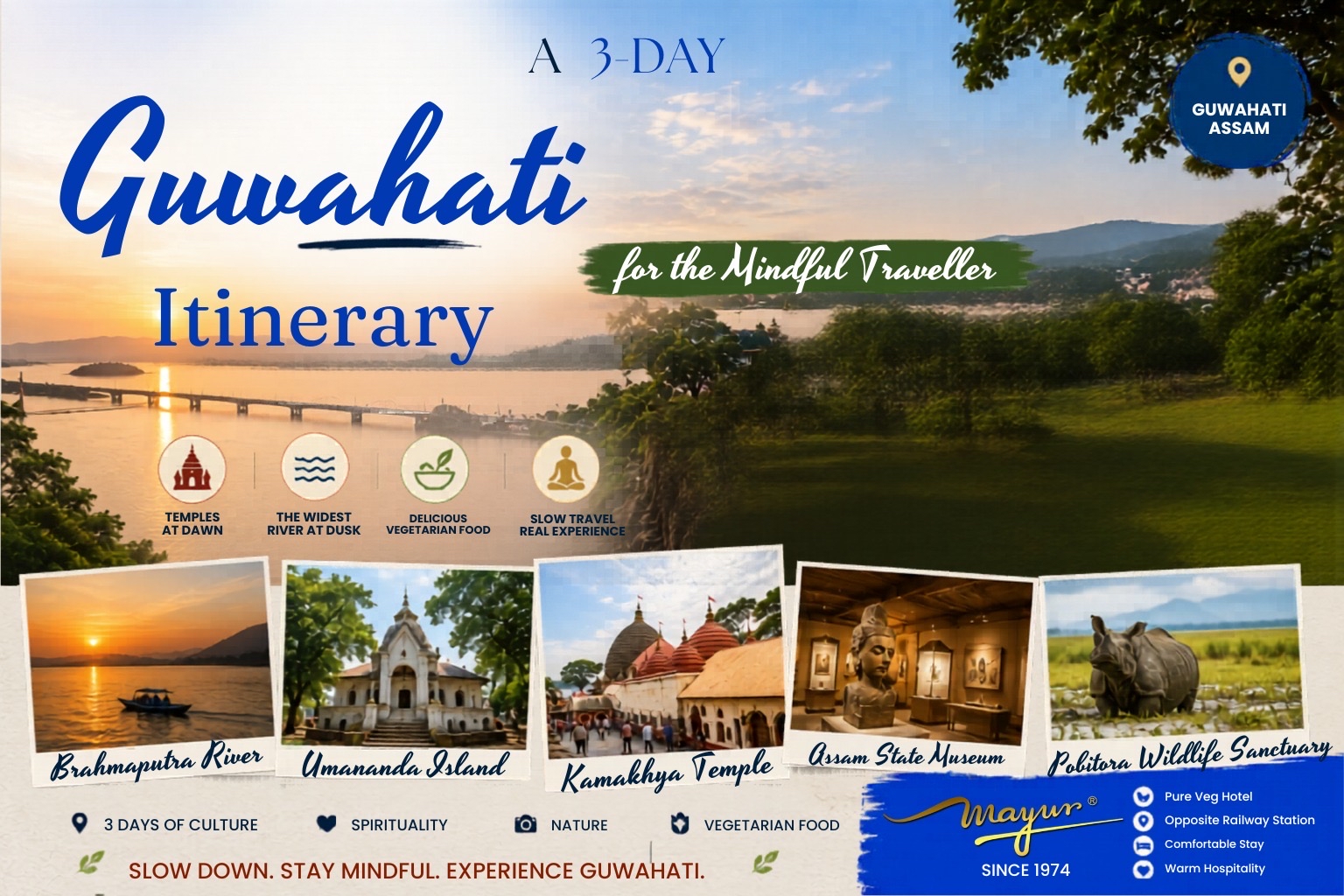
Temples at dawn, the widest river in the world at dusk, and the most unexpectedly delicious vegetarian food you will find in Northeast India.
Most travellers pass through Guwahati. It is the gateway to the Northeast, the city you land in before pressing on to Kaziranga, Shillong, or Meghalaya's living root bridges. But spend three days here with intention, and you will discover a city that rewards slowness: a riverfront that changes colour by the hour, temples that have been drawing pilgrims for centuries, and a cuisine that is so singular it has no real parallel elsewhere in India.
This itinerary is designed for the mindful traveller, someone who prefers a morning walk over a rushed checklist, who eats with curiosity, and who finds meaning in the quieter corners of a place. Based at Mayur Hotel Guwahati, opposite the railway station and a short ride from every site in this guide, you are positioned at the heart of it all.
DAY 1 - Arrival, River and the Neighbourhood
Morning - Settle In, Then Walk
Arrive, drop your bags, and take a breath. Guwahati doesn't reward the rushed. Start your morning at our Govind's Restaurant. Afterward, step out into Paltan Bazar. It is a sensory overload, the smell of strong Assam tea, the shimmer of Muga silk in the windows, and the constant hum of the railway station nearby. It is the city's heartbeat. Walk through it, don't just pass by.
Paltan Bazar is one of Guwahati's oldest commercial quarters. It hums without being overwhelming. Silk merchants display Muga and Eri fabrics. Small tea stalls serve Assam's finest, brewed strong and sweet. If you have never bought loose leaf Assam tea directly from someone who knows it, this is the morning to do it.
Afternoon - Umananda Island Temple
Take a ferry from Umananda Ghat, a short ride from the hotel, to Umananda Island, home to one of India's smallest inhabited river islands and a Shiva temple that dates to the 17th century. The crossing takes barely ten minutes but feels like a genuine transition: the city recedes, the Brahmaputra opens up, and the air changes to feel the mist of the Brahmaputra on your face.
The temple itself is modest in scale but extraordinarily atmospheric, particularly in the afternoon light when the river turns from silver to bronze. Walk the island slowly. There is almost nothing to buy and nowhere to rush. That is precisely the point.
Evening - Brahmaputra Riverside
Return to the mainland and spend the early evening at the Brahmaputra riverfront. Guwahati sits on the south bank of one of the world's great rivers at certain points nearly twenty kilometres wide and watching it at dusk is one of the genuinely moving experiences of northeastern India.
Dinner back at the hotel: Govind's Restaurant serves an Assamese thali that is a worthy introduction to the cuisine, dal made from black lentils, seasonal greens with minimal spice, and rice noticeably more fragrant than what you find further west. If you prefer to eat under the sky, the Rooftop Restaurant is open until 11 PM with views over the city.
DAY 2 - The Sacred Hill and the Living Museum
Early Morning - Kamakhya Temple
Rise early. Before you leave, pick up something from the 24-hour Pastry Corner in the hotel lobby, the easiest fuel before a sunrise climb. Kamakhya Temple, perched on Nilachal Hill overlooking the city, is best visited before the heat builds and before the midday crowds. It is one of the most significant Shakti shrines in India, a place of genuine spiritual gravity, regardless of your own beliefs.
The walk up the hill, if you take the steps rather than the road, is meditative. The view from the temple complex over the Brahmaputra and the city below is extraordinary. Spend time here without hurry. The temple's architecture, the devotional energy of its morning visitors, the smell of incense and marigold it stays with you.
Late Morning - Assam State Museum
Head to the Assam State Museum near Dighali Pukhuri tank in the heart of the city. The collection covers the full arc of Assam's extraordinary history from the Ahom kingdom's centuries of rule to the colonial period and the emergence of modern Assam.
The textile collection is particularly remarkable. Assam's weaving traditions are among the most sophisticated in Asia, and seeing the actual garments the mekhela chador, the intricate Muga silk pieces makes the fabric stalls of Paltan Bazar the previous day make far more sense.
Afternoon - Srimanta Sankardev Kalakshetra
This cultural complex on the western edge of the city is a living repository of Assamese arts, crafts, and performing traditions. Museums dedicated to Assam's different communities, an open-air theatre, and resident artisans you can watch at work, weavers, mask-makers, traditional instrument builders. It is unhurried, uncrowded by Indian standards, and genuinely illuminating. Budget two hours.
Evening - Local Market and Rest
A quiet evening. Walk through Fancy Bazar if you have energy, Guwahati's main commercial street, more local in character than tourist-oriented, or simply return to the hotel. Dinner tonight: ask what is freshest from the menu. For couples or solo travellers, the Double Executive room makes a well-priced, comfortable base for evenings like this.
DAY 3 - Day Trip to Pobitora & Departure
Full Day - Pobitora Wildlife Sanctuary (Optional)
If your schedule allows an early start, Pobitora Wildlife Sanctuary, about an hour's drive east of Guwahati offers one of the highest densities of Indian one-horned rhinoceroses in the world.
Morning jeep safaris depart around 7am. The Mayur Hotel Guwahati can arrange your car the evening before travel.
If Staying in the City
Spend the morning at Ugratara Temple or the quieter Navagraha Temple on Chitrasal Hill - nine shrines arranged around the nine celestial bodies of Indian astrology, with commanding city views and none of the bustle of Kamakhya. Families travelling together will find the Family Villa and Family Deluxe rooms at Mayur a comfortable base for a relaxed final morning before checkout
Lunch at the hotel, then a final walk through Paltan Bazar for last-minute silk purchases. The airport is well-connected; give yourself ninety minutes from the city centre.
Practical Notes for Your Guwahati Visit
Getting Around
Auto-rickshaws and app-based cabs (Ola works well here) are the easiest options. Umananda ferry ghats are a short ride from Mayur Hotel Guwahati. For Pobitora, pre-arrange a car through the hotel concierge the evening before.
Best Time to Visit
October through March is ideal - dry, cool, and clear. Summers are warm and humid. Bihu season (April and October) brings the city alive with cultural performances.
What to Pack
- A light shawl or dupatta for temple visits - shoulders and heads should be covered at major shrines.
- Comfortable walking shoes - Kamakhya involves significant steps.
- Cash for ferry crossings and market purchases; digital payments are available but not universal.
- An appetite for new flavours - Assamese cuisine is unlike anything else in India.


