
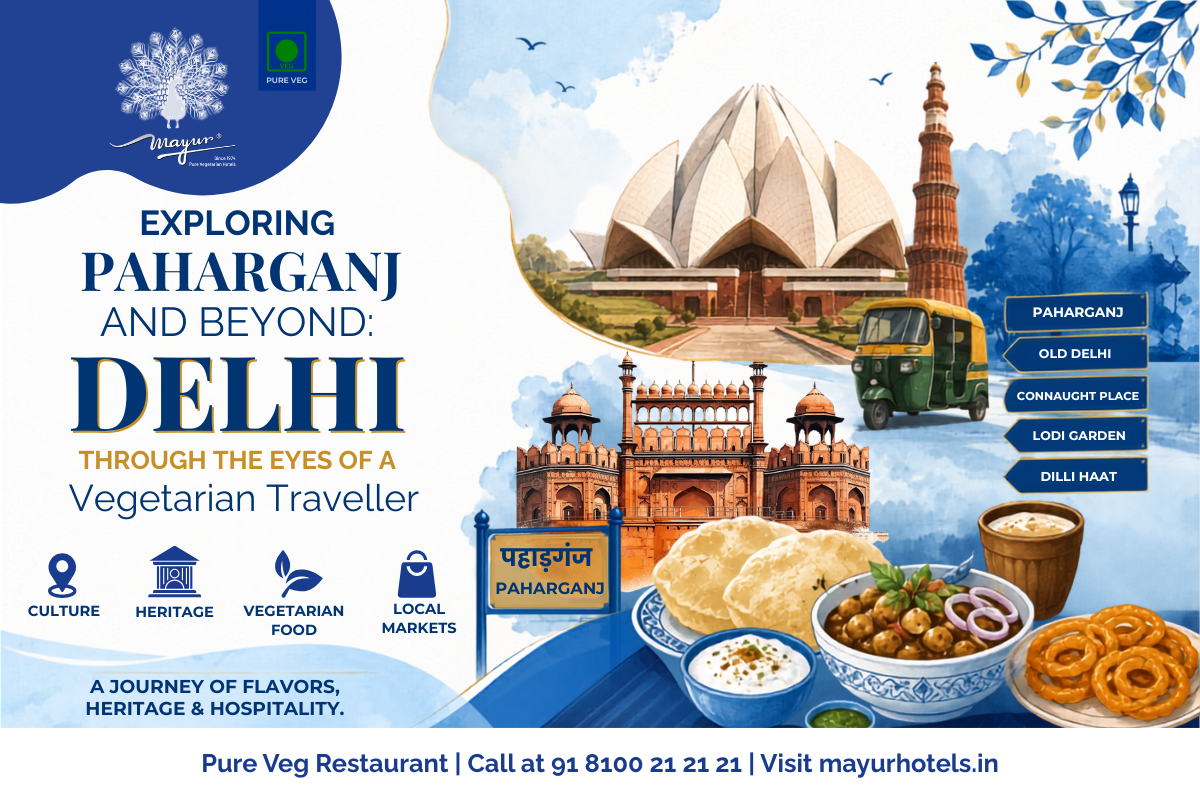
Delhi has a reputation for being tough. Loud, crowded, impossible to navigate, and full of street food that could go either way. For the vegetarian traveller, there is an extra layer of uncertainty: which places can you actually trust, and where do you eat when you want something proper rather than a bag of crisps from a convenience store?
The honest answer is that Delhi is one of the best cities in India for a vegetarian to eat well. The food culture here is deeply rooted in North Indian and Punjabi tradition, and so much of it is naturally vegetarian. Chole bhature, dal makhani, stuffed parathas, paneer in a dozen different forms, chaat in every lane. The city was always on your side. You just need someone to show you around.
This guide is built around Mayur Hotel New Delhi, our pure vegetarian property on Arakashan Road, Paharganj. It is the right base for this kind of trip: central, easy to get in and out of, and walking distance from the railway station and the metro. Everything in this guide is reachable from there.
DAY 1 - Paharganj and Old Delhi
Morning: Start With Paharganj Itself
Most travellers treat Paharganj as a place to pass through. That is a mistake. The Main Bazaar, which runs parallel to the railway station, is one of the most genuinely interesting streets in Delhi. It is chaotic in the way that only old Indian bazaars can be, and the chaos is the point.
Walk it in the morning before the heat sets in. The shops selling silver jewellery, embroidered bags, Tibetan artefacts, and stacks of cotton clothing open early. Street food stalls begin frying at 7 AM. You do not need to buy anything. Just walk it, take it in, and let the city introduce itself.
Late Morning: Across to Old Delhi
Take the metro from New Delhi station one stop to Chandni Chowk. Old Delhi is a different city entirely. The streets are narrower, the pace is faster, and the food is everywhere.
Parathe Wali Gali is the lane you come for first. It has been serving stuffed parathas since the 1870s and the format has not changed. You sit on a bench, you say yes to whichever filling is offered, and a hot paratha arrives with a small bowl of sabzi, pickle, and curd. The potato filling is the one to order on your first visit. The paneer and cauliflower are for when you come back.
Nearby, Old Famous Jalebi Wala opens at 8 AM and the jalebis come straight from the wok. They are crisp on the outside and syrupy inside. You eat them standing on the street. This is non-negotiable.
Also in Chandni Chowk: the dahi bhalla stalls along the main road have been doing one thing for decades and doing it perfectly. Lentil dumplings in cold yoghurt with tamarind chutney — this is what Delhi chaat is all about. For chole bhature, look for the oldest, most crowded stall you can find near Fatehpuri Masjid. Small, crowded, and the food is worth the wait.
Afternoon: Khari Baoli and the Spice Market
Walk west from Chandni Chowk towards Khari Baoli, Asia's largest wholesale spice market. Even if you do not intend to buy anything, it is worth an hour of your time. The smells are extraordinary: turmeric, cardamom, dried chillies, and a hundred things you may not be able to name. The market is as much an experience as it is a place to shop.
After Khari Baoli, head back toward the metro. The afternoon in Delhi is best spent resting. The heat between 1 PM and 4 PM is serious, and the city is more enjoyable when you are not fighting it.
Evening: Connaught Place
Take the metro to Rajiv Chowk for Connaught Place in the evening. The circular architecture of CP, built in the 1930s, is most pleasant at dusk when the light softens and the crowds ease. The inner and outer circles are full of restaurants, most of which have solid vegetarian menus.
For dinner, the chaat at the small stalls around Block A and Block B is the most reliable choice. Rajma chawal and chole kulche appear at almost every stall here. Eat standing, eat slowly, and watch the evening crowd move through one of the most elegant public spaces in Delhi.
DAY 2 - Monuments, Markets and the South of the City
Morning: Humayun's Tomb
Start early, before 9 AM if you can. Humayun's Tomb is a UNESCO World Heritage Site and one of the most beautifully proportioned buildings in India. It is the structure that preceded the Taj Mahal, and in many ways the quieter, more human version of it. The gardens are wide and the crowds are thin in the morning.
Give it 90 minutes. Walk the full garden, go inside the tomb, and find a shaded spot to sit for a few minutes before moving on. There is no rush.
Late Morning: Lodhi Garden
A 10-minute auto ride from Humayun's Tomb brings you to Lodhi Garden, a 90-acre park built around Mughal-era tombs and used by Delhi as a morning walking ground, picnic spot, and cricket pitch simultaneously. It is a good antidote to the city if you have been moving fast.
The Mohammed Shah's Tomb and Sikander Lodi's Tomb are both inside the park and worth a look. The garden is also one of the better places in Delhi to see birds if that is something you pay attention to.
Afternoon: Dilli Haat
Dilli Haat on INA Road is a government-run crafts market that brings together artisans from every Indian state. Each stall represents a different region: Rajasthani textiles, Kashmiri shawls, Assamese silk, Kerala spices, Bengali kantha work. The quality is generally high and the pricing is fixed, which makes it a more relaxed shopping experience than most Delhi markets.
The food stalls at Dilli Haat are organised by state too. For a vegetarian, this is genuinely interesting: you can eat Rajasthani dal baati churma, South Indian dosa, and a Bengali mishti doi in the same afternoon. It is the closest thing Delhi has to a curated food tour.
Evening: Back to Paharganj
End the evening close to the hotel. The rooftop cafes in Paharganj, several of them on the upper floors of buildings along the Main Bazaar, have the kind of relaxed, traveller-friendly atmosphere that is hard to find in the more polished parts of Delhi. The food is simple: paneer tikka, dal fry, some version of a thali. The views over the bazaar as the street lights come on are worth sitting for.
The Double Executive rooms at Mayur Hotel are a good base for this kind of day. Well-sized, quiet, and close enough to everything that you are not wasting an hour commuting at either end.
DAY 3 - Karol Bagh, Gurudwara Bangla Sahib and Departure
Morning: Gurudwara Bangla Sahib
This is the most visited Sikh gurudwara in Delhi and one of the most welcoming public spaces in the city. You do not need to be Sikh to enter. Cover your head, remove your shoes at the entrance, and wash your hands at the tank outside. The golden dome reflects in the large sarovar (pool) and the inside is calm and beautifully kept.
The langar — the free community kitchen that every gurudwara runs — serves simple vegetarian food to anyone who comes. Dal, roti, rice, and a sweet. You sit on the floor alongside pilgrims, families, and fellow travellers and eat together. It is one of the more quietly moving experiences Delhi has to offer, and it costs nothing.
Late Morning: Karol Bagh Market
Karol Bagh is where Delhi actually shops. Not the tourist version of shopping but the real version: bridal jewellery, household items, fabric by the metre, readymade clothes for every budget. The food stalls here are also excellent and very much aimed at locals rather than visitors.
Aloo tikki at one of the Karol Bagh carts is the thing to eat here. The tikki is fried until the outside is crisp, then topped with chole, chutneys, yoghurt, and sev. It costs very little and tastes better than most restaurant meals. Kulfi falooda from one of the dairy stalls is the afternoon version of the same impulse: sweet, cold, and generous in portion.
Afternoon: Akshardham or Rest Before Departure
If you have time before your train or flight, Swaminarayan Akshardham on the eastern edge of the city is worth the journey. The complex is enormous and the architecture, exhibitions, and gardens are genuinely impressive. It is one of the largest Hindu temples in the world and the level of craft inside, whether or not it is your tradition, is difficult not to be moved by.
Allow three hours minimum. Bags and cameras must be deposited at the entrance. Photography is not permitted inside the main complex.
For families travelling with children, the Family Villa and Family Deluxe rooms at Mayur Hotel give everyone enough space to regroup between days like this. The hotel is a short auto ride from New Delhi Railway Station and well connected to the airport by metro.
A Quick Reference: Where to Eat in Delhi as a Vegetarian
Old Delhi
- Parathe Wali Gali: Stuffed parathas served with sabzi and pickle, eaten on a bench. Go for potato or cauliflower filling.
- Old Famous Jalebi Wala: Hot jalebis from the wok, eaten standing on the street. Opens at 8 AM.
- Dahi bhalla stalls on the main Chandni Chowk road: Cold yoghurt, tamarind chutney, and lentil dumplings. The oldest chaat tradition in the city.
- Chole bhature near Fatehpuri Masjid: Look for the most crowded stall. Small portions, big flavour, worth the queue.
Paharganj
- Street food stalls along the Main Bazaar: Aloo puri, chole, and fresh chai from 7 AM. Eat standing, eat early.
- Rooftop cafes on the upper floors along the bazaar: Simple thalis and dal fry in a relaxed setting. Good for evenings.
Connaught Place
- Street chaat stalls around Block A and Block B: Rajma chawal and chole kulche from the inner circle stalls. Simple and filling.
Dilli Haat
- State food stalls: One thali from a different state each visit. Rajasthani dal baati churma and South Indian dosa are the reliable choices for vegetarians.
Karol Bagh
- Aloo tikki carts: Fried crisp, topped with chole and chutneys. Eaten standing.
- Kulfi falooda stalls: The right way to end a morning in the market.
Getting Around Delhi
The Delhi Metro is the easiest way to move between neighbourhoods. New Delhi Railway Station (Yellow Line) connects directly to Chandni Chowk, Connaught Place (Rajiv Chowk), and the airport. Auto-rickshaws and app-based cabs fill the gaps for shorter distances.
Paharganj is walkable for most Mayur Hotel guests. The Main Bazaar, Multani Dhanda, and the surrounding lanes are all within 10 to 15 minutes on foot. For Karol Bagh, Lodhi Garden, and Dilli Haat, take an auto or book a cab.
The heat in Delhi between April and June is intense. Plan outdoor sightseeing for the morning and late afternoon. Rest in the middle of the day. Drink water constantly.
Delhi rewards the vegetarian traveller more than almost any other Indian city. The food culture is on your side from the moment you arrive. You just need a reliable place to come back to at the end of the day.
To book a room at Mayur Hotel New Delhi, WhatsApp us directly or call 8100 21 21 21. We are a pure vegetarian hotel on Arakashan Road, Paharganj, a short walk from New Delhi Railway Station and everything in this guide.


